
Train Hall Lighting: LED solution for DB Regio in Munich-Pasing
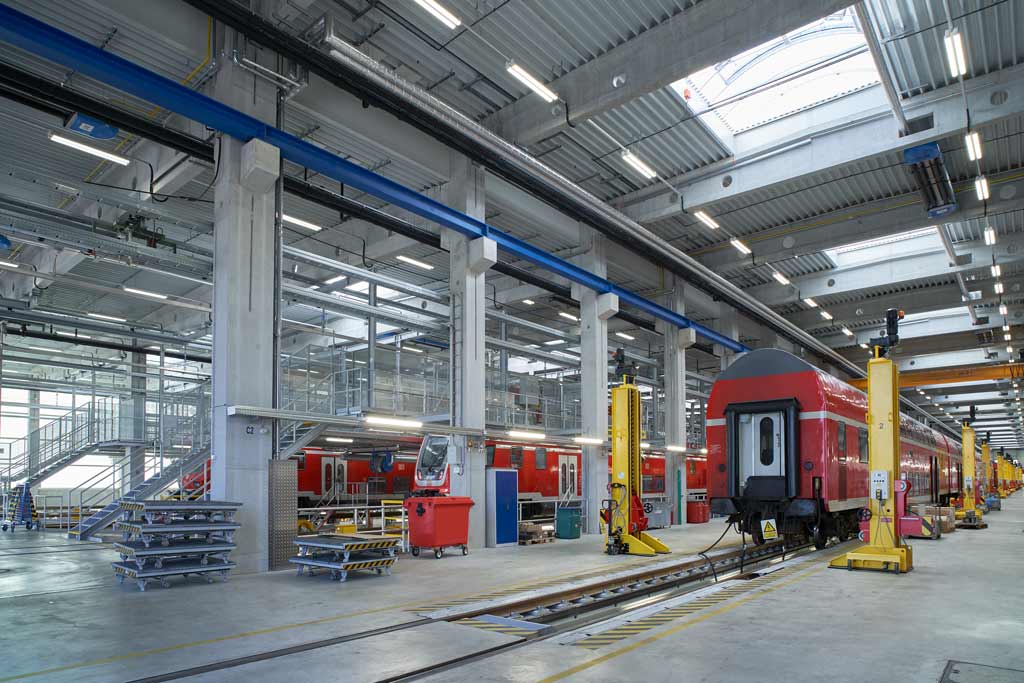
One Germany’s most modern repair halls for trains can be found in Munich. For its locomotives and railcars that operate in Bavaria, DB Regio AG opened a new vehicle maintenance and handling facility west of the Munich-Pasing train station in the autumn of 2017. Here, trains are inspected top to bottom and made ready for the track again.
Luminaires from NORKA guarantee good visibility and safety for the wide variety of tasks performed during such a “pit stop.” A sensor-based lighting control system also enables particularly efficient operation and easy maintenance of the lighting.
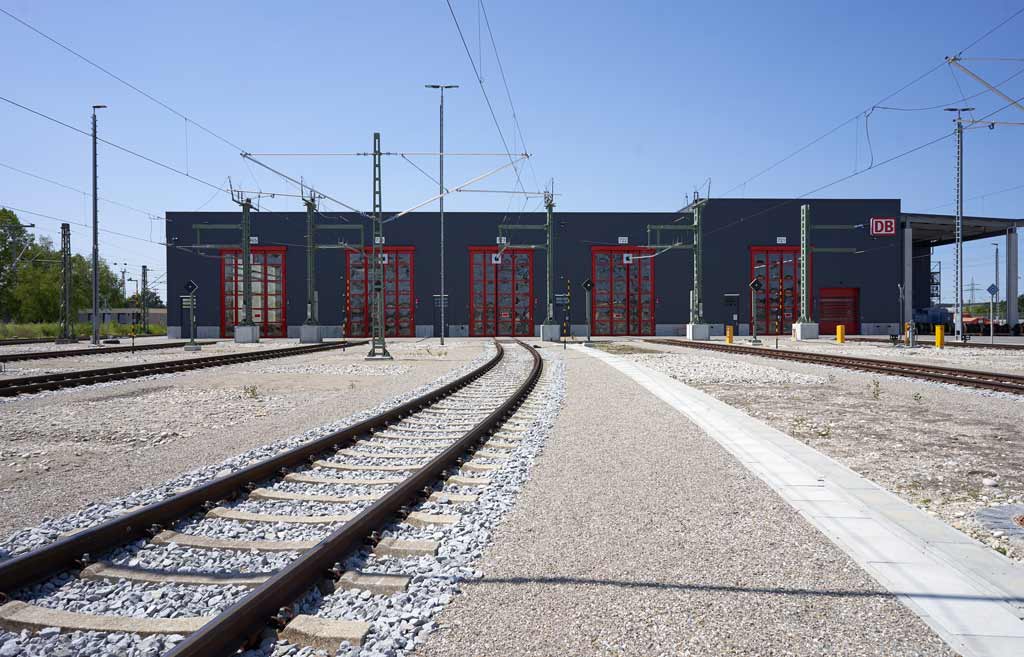
LED Hall Lighting for Locomotives and Carriages at DB Regio Munich-Pasing
58 metres wide and 207 metres long, the hall contains the new vehicle maintenance and handling system (referred to as “FIBA”) of DB Regio AG. In five maintenance lines and on three different levels, about 150 employees can work on the trains at once. In order to make the railcars and locomotives ready for operation again as soon as possible, the FIBA has been equipped with a variety of technical innovations. Particularly impressive is a hydraulic jack system that can raise an entire train, therefore allowing fast changing of the wheels.
A lot of time is also gained, however, due to the busbars running above the maintenance lines. Powered by these components, the trains can enter the hall without the need for an additional shunting locomotive. The logistics for the approximately 6,000 spare parts on stock has also been implemented in an especially clever manner. No one has to make an extra trip to get the part out of a central warehouse. On touch screens distributed across the hall, the employees select what they need and a material shuttle similar to a paternoster delivers the needed component in the vicinity of the current workstation. The lighting technology installed in the FIBA is also innovative and intelligent. NORKA has provided 1,600 luminaires in total, which are linked through the XARA lighting control system. In addition, NORKA is also responsible for the entire light planning, as well as the design and programming of the control concept.
Train Hall Lighting on Three Levels with ERFURT LED
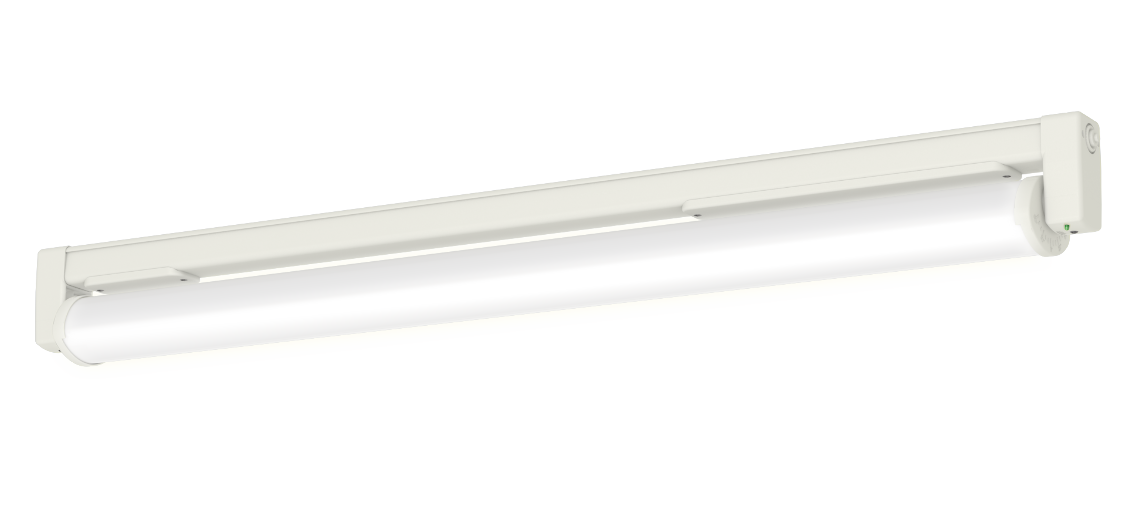
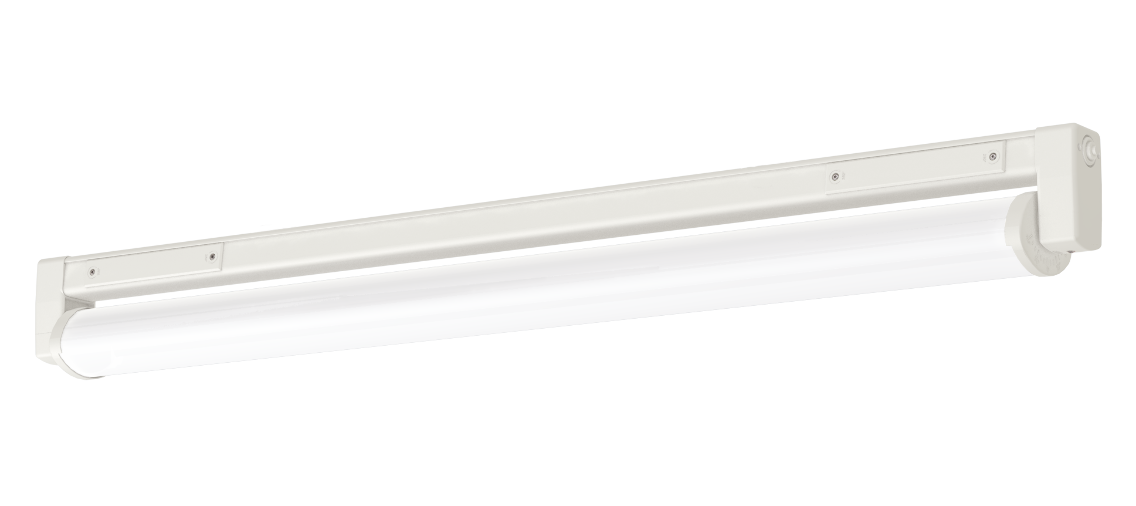
In the hall, luminaires have been installed on three levels, flanking both sides of the five maintenance lines. NORKA luminaires of the type ERFURT LED hang directly from the ceiling of the hall. The two-lamp version with a reflector tube used here creates excellent vision conditions when working on the roofing work platforms at a height of four metres. The current collectors of the railcars and air conditioners, for example, are maintained from these platforms.
ERFURT LED luminaires – in the single-lamp version in this case – are also installed on the bottom side of the roofing work platforms. From this position, they assume the general lighting of the hall; i.e., they are absolutely vital for all work performed in and around the trains between their roofs and the bottom edge of the platform.
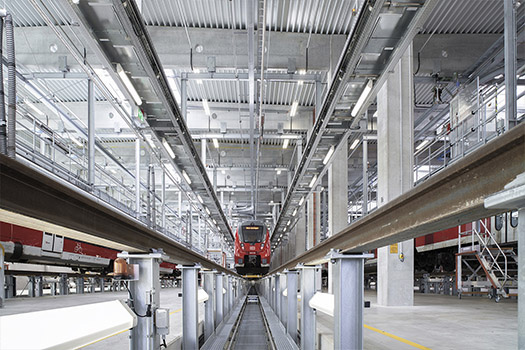
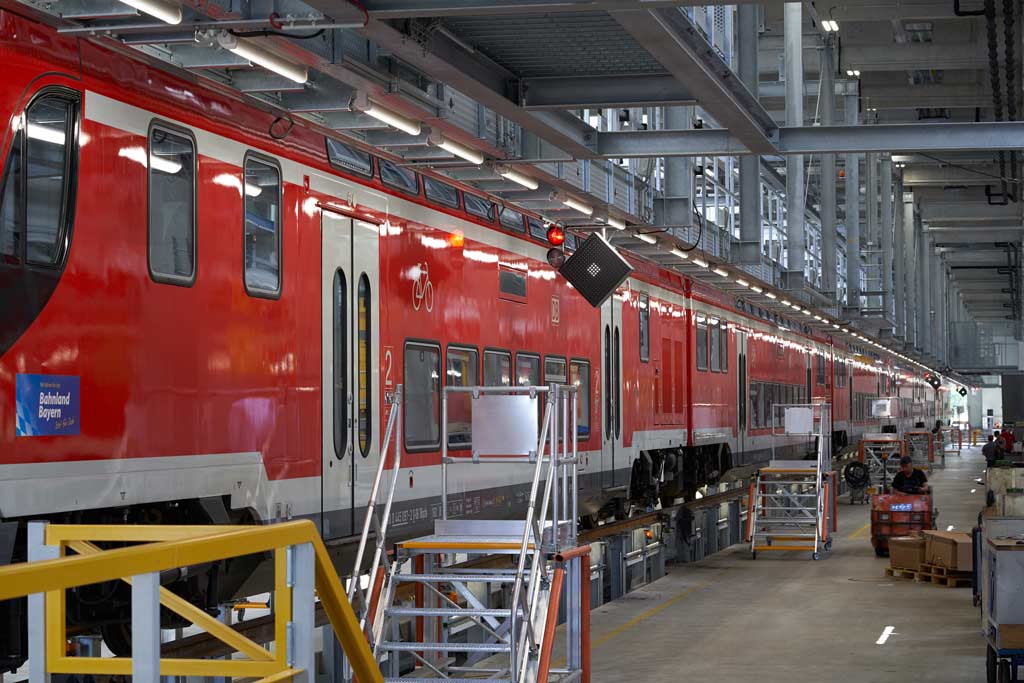
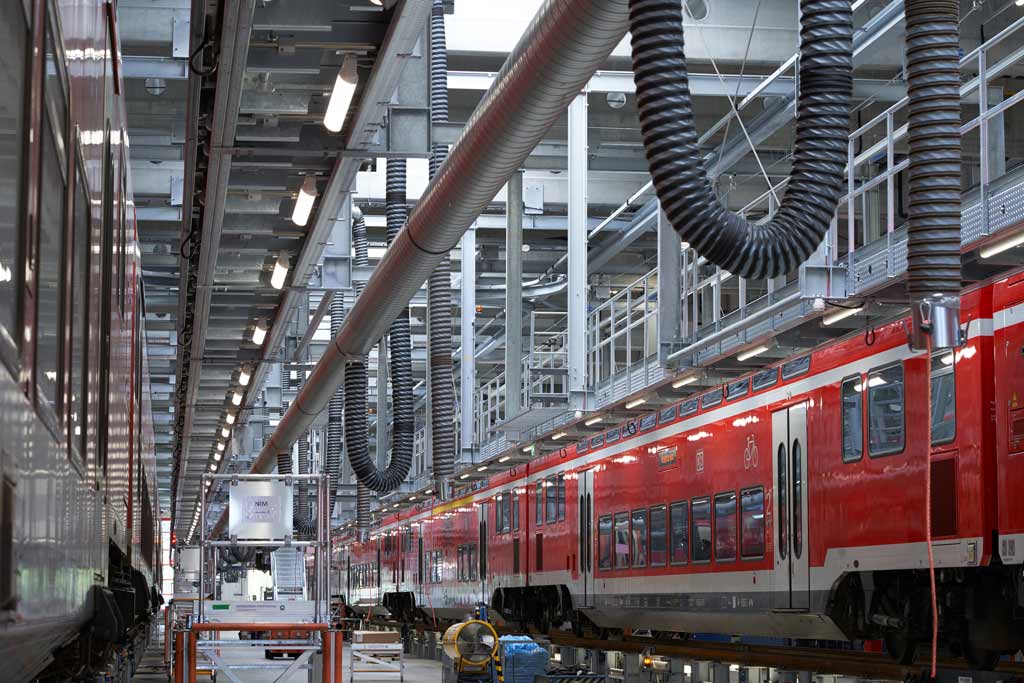
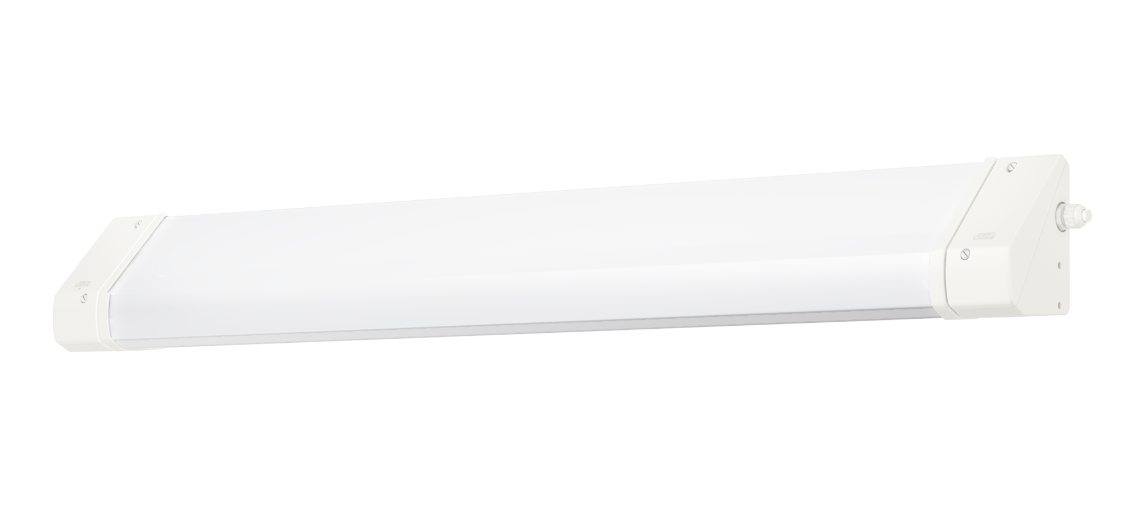
The FIBA workers require the third lighting level for inspection and repair work on the underbodies of the railcars. They also act as work pit lighting. Classic work pits, however, have not been installed in the hall. Instead, the rails on which the trains stand for maintenance are elevated. A luminaire of the type FULDA LED has been placed in every second intermediate space between the supports. Its inclined-beam reflector tube directs the light exactly on the underside of the trains and on the floor of the pits. With these luminaires, NORKA has proven its know-how and flexibility due to the quick, product-specific adaptation of the light distribution to the requirements of Deutsche Bahn. The latter requires an illumination level of 100 lx on the floor and 300 lx on the train, as good visibility is essential for the work performed in these areas. From the pits, for example, the wheels are tested for material defects using ultrasonic instruments and the brake linings are inspected.
Intelligent Train Hall Lighting with XARA Light Control
Even though NORKA luminaires have a drastically low connected load in comparison with conventional lamps thanks to their LED technology, the implementation of a lighting control system for the project was an obvious choice in view of the large number of luminaires and the varying degrees of use of the different parts of the hall. NORKA was able to act as a full-service provider in this case, providing LED luminaires and the XARA light management system as a single-source solution. Here, NORKA partner company and control intelligence specialist NORKA AUTOMATION has developed an overall solution adapted to the special requirements. Three programmable logic controllers (PLC) operate and regulate the luminaires of the FIBA from a switch cabinet. The PLCs send their commands to a total of 2,100 light points through DALI (Digital Addressable Lighting Interface).
120 presence detectors and 35 daylight sensors from the XARA portfolio provide the lighting control input. As a result, the luminaires regulate their luminous flux up or down depending on the incident daylight coming through the skylights. Light therefore goes on only where it is actually needed. The lighting of the work pit, for example, is generally implemented only in exactly those 25 to 50 metre sections in which the radar presence detectors can sense employees. In comparison with the permanent lighting across the entire 200 metres length of the pit, considerable energy savings are achieved.
If the lighting required deviates from the standard daily operation, the system can be regulated and operated manually on control panels distributed throughout the hall. Such an action is frequently necessary in rail sections in which paintwork is currently being performed, for example. Here, an additional switching stage is available by means of which the luminaires generate an illumination level of 500 lx on the surface of the train instead of the usual 300 lx.
Efficient Monitoring and Maintenance with XARA
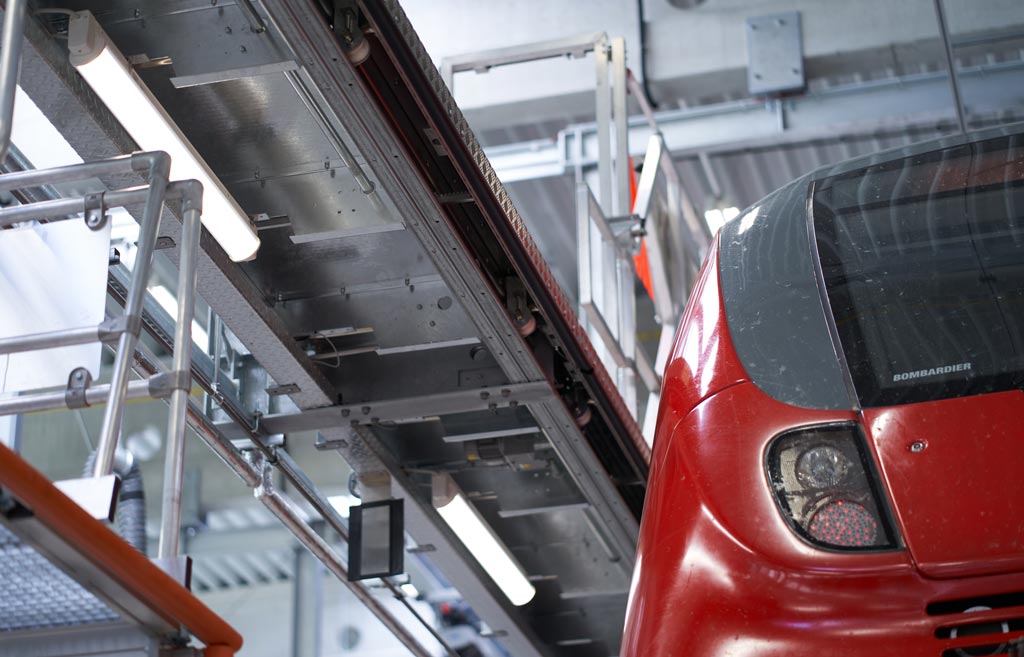
Lighting control with the XARA system therefore guarantees noticeable energy savings and thus lower costs for the operation of the luminaires, whilst supporting the operating company in system maintenance. The electronic transformers of the luminaires not only receive switching commands from the PLC, but they also return data. Parameters such as operating duration, operating current or temperature can be recorded, saved in the PLC and visualised in a web browser by a graphical user interface. Amongst other functions, such monitoring is of interest for system optimisation and fault control.
In the FIBA, this function is used actively to performed the emergency lighting tests and create the pertinent documentation. NORKA luminaires of the type COBURG LED are installed at the hall gates and entrances to the work pits. With a battery pack and special transformer, these luminaires are used for emergency lighting in case disaster strikes. The function of both these 15 single-battery luminaires and the 50 escape route luminaires in the hall are tested automatically using the XARA lighting control system. A systematic documentation of the test results according to standard requirements can be accessed at any time.
Reliable and Robust Even Under Harsh Conditions
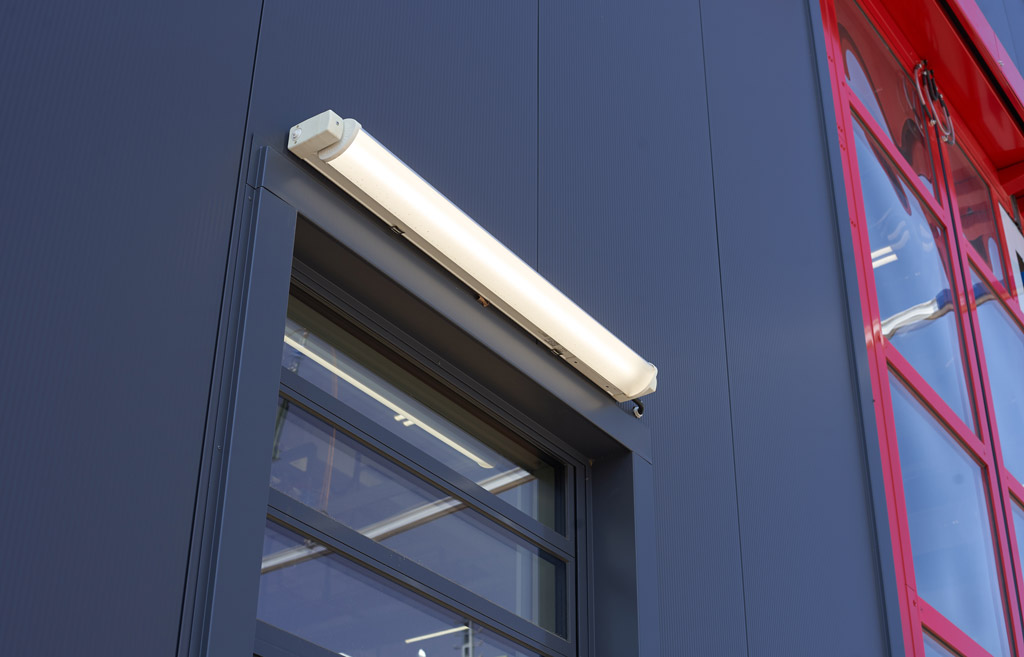
With the commissioning of lighting expert NORKA, DB Regio AG has chosen an optimum illumination solution that is not only efficient and intelligent, but particularly reliable and long-lasting as well. NORKA is a specialist for light under extreme environmental conditions, which means that the rough environment of the maintenance area is no problem for the NORKA luminaires. Resistant to oil and lye, impacts, high and low temperatures and vibrations, they even hold their ground where standard products often capitulate. A sealing system made of non-ageing silicone/synthetic rubber and protection rating IP65 also prevent the penetration of soot, dust, liquids or insects into the luminaire housing and permit the cleaning of the luminaires by water jet. And what applies for luminaires also applies for the hardware of the lighting control system: The sensors, control and touch panels and interface modules of the XARA program are also adapted for use under demanding conditions. As a result, the lighting in the FIBA performs extremely well during the maintenance of the trains without requiring maintenance itself.
Products used
Do you agree to the use of Matomo?