
LED retrofitting: Approaches to upgrading industrial lighting.
Bringing an outdated lighting system up to the latest standards and switching from fluorescent tubes to LEDs requires a well-planned approach. The reasons for modernisation are usually reduced light quality due to outdated light sources, the withdrawal of the obsolete light source from the market as part of a phase-out, or a company’s own efforts to save energy. Switching to LED improves lighting quality and enhances user comfort. Professional luminaire refurbishment also makes it possible to preserve historic or unique luminaires. Below, we outline a range of options for LED retrofitting in industrial and warehouse lighting.
Table of Contents
Starting point: Existing system
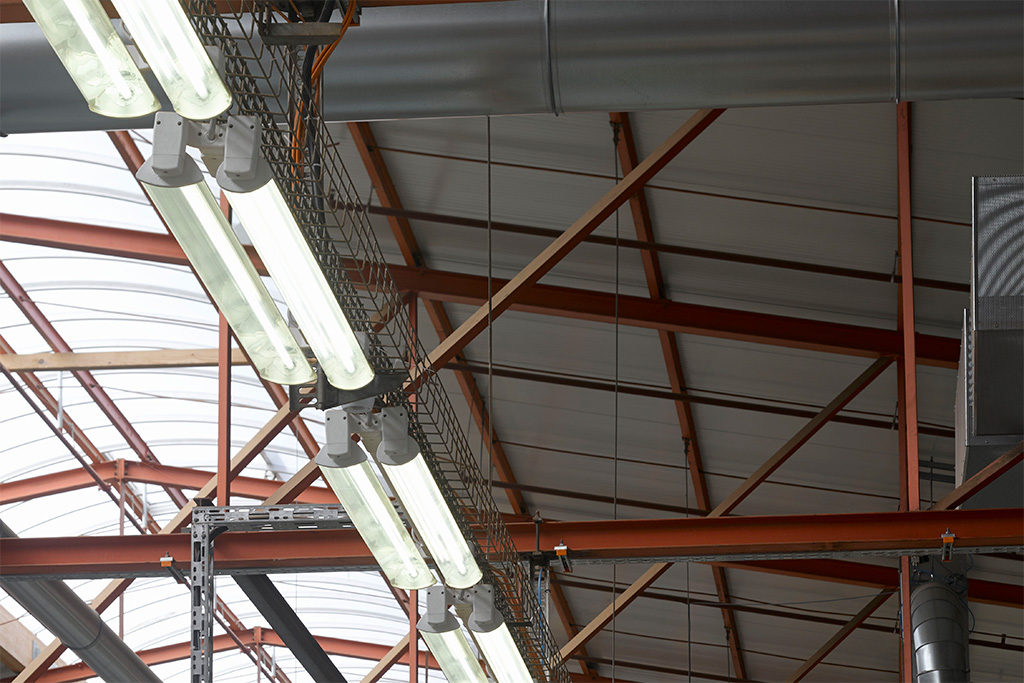
Assessing the current situation and clarifying requirements.
The first step is to take a close look at the existing system and clarify fundamental questions about the environment and the requirements of the lighting system: Have the lighting requirements for the area changed or not? What is the condition of the current installation and luminaires? Are there any changes to standards that need to be considered? What requirements will be placed on the system in future?
If the products are still in good condition and all standard-related and photometric requirements are unchanged, options such as retrofit kits or LED tubes may be considered. If luminaires with VDE/ENEC marking are needed, a detailed examination of the intended solution is necessary. A detailed assessment and risk analysis must be conducted before a final decision can be made.
Consider the legal situation.
Regardless of the approach chosen, the legal situation must always be considered. Depending on the solution, the obligations of the operator and the retrofitter differ considerably. In all cases, the person responsible must conduct a risk assessment of the retrofit.
Retrofit kit
When discussing luminaire refurbishment, the topic of retrofit kits or replacement kits often arises. In this approach, the luminaire housing is kept and the internal components are replaced. There are generally three types, or ‘levels’, of retrofit kits: universal, product-specific and customised.
Universal retrofit kit
With a universal retrofit kit, the internal components of the conventional luminaire are removed and replaced with a complete LED set. This may result in limitations when it comes to meeting photometric requirements.
Advantages
Various designs.
Disadvantages
Illuminating engineering requirements often not met.
Significant variations in quality.
Usually not suitable for very high protection ratings.
Product-specific retrofit kit
Certain luminaire manufacturers offer a product-specific retrofit kit, which tailored to the technical requirements and characteristics of the luminaire to be retrofitted. Compliance with photometric, electrical and regulatory requirements is guaranteed by the manufacturer. Our NORKA RENOKITs are an example of this.
Advantages
Tailored to the product.
Compliance with photometric and regulatory requirements.
Disadvantages
Usually cannot be used with specially encapsulated luminaires.
Customised retrofit kits
In certain cases, other circumstances stand in the way of a refurbishment: the existing luminaire must be kept structurally. This may be necessary due to listed building regulations, technical considerations or financial reasons.
Advantages
Compliance with lighting and regulatory requirements.
Also available for products from other manufacturers or those no longer on the market.
Specific requirements can be accommodated on a case-by-case basis.
Disadvantages
Only practical for large quantities.
Customised retrofit kit: a solution for special existing luminaires
Many manufacturers now offer the retrofit kits, but not every manufacturer is still active on the market. What solutions are available if the manufacturer of the installed luminaires is no longer on the market? As a specialist lighting manufacturer with its own lighting laboratory and production facilities, NORKA can develop customised retrofit kits for various types of luminaires.
LED tubes
LED tubes are used as a replacement for conventional fluorescent tubes and are managed in an equivalent way. But please note there is a difference between retrofit lamps and conversion lamps. Whilst with retrofit lamps only the light source and the starter are swapped or replaced by a current bridge, with conversion lamps the internal components of the luminaire are changed and rewired. This makes the legal situation more complex than with retrofit lamps.
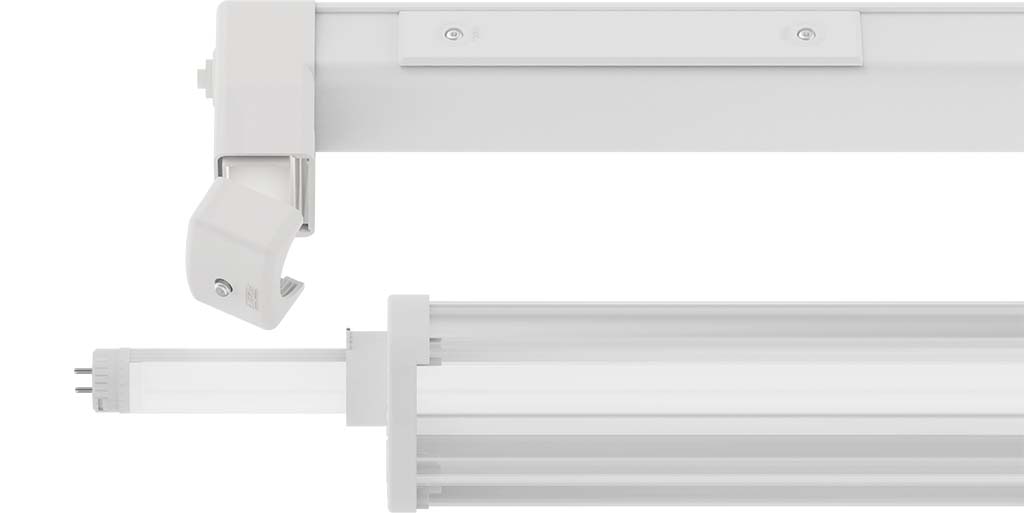
Advantages of retrofit lamps
Familiar handling
With standard sockets and a current bridge, the process is like replacing fluorescent tubes and starters.
Lamps freely available for purchase
A wide range of lamps is available on the market; as a customer, you are not tied to a single supplier. However, there are correspondingly significant differences in quality within the market for LED tubes.
Disadvantages of retrofit lamps
Lighting characteristics
LED tubes have different light distribution curves to traditional fluorescent tubes. This affects the lighting characteristics achieved.
Limitations on technical specifications
It is not always possible to use LED tubes: emergency lighting or ENEC certification require separate consideration.
NORKA offers FIT luminaires which, when used in combination with approved lamps, are VDE and ENEC certified.
Refurbishment
Like the ‘refurbishment’ process familiar in the consumer sector, it is also possible to fully refurbish luminaires and convert them to LED. The luminaires are cleaned, evaluated, and serviced by the manufacturer; where necessary, they are fitted with new seals and membranes and equipped with LEDs and the proper ballast.
Luminaire refurbishment by the manufacturer can be particularly beneficial for very high-quality, durable housings and larger projects. Often, these luminaires are customised designs that were already tailored to the customer’s requirements during their first life cycle, and replacing or developing them from scratch would entail significant financial costs.
1:1 luminaire replacement
If the condition of the old system is no longer satisfactory – for example, because the plastic has become brittle, or the luminaire housing is otherwise damaged – a 1:1 luminaire replacement may also be the proper solution. In this process, the old luminaires are removed, and new, modern LED luminaires are installed in their place.
Advantages of the 1:1 exchange
Existing installation stays in place.
Both mounting points and wiring can be kept. This reduces installation costs.
Suitable for emergency lighting, high IP ratings and in EX zones.
Specific technical requirements, such as a high IP rating, ATEX certification or operation as an emergency light, can usually be met at once by using new luminaires.
Latest technical innovations integrated.
New purchases incorporate the latest innovations, such as the interchangeability of LEDs – for example, with easy eXchange – or a DALI driver.
Disadvantages of a 1:1 replacement
Limited design flexibility.
As the existing installation points are kept, design flexibility is limited, and new space utilisation requirements may sometimes not be met.
Redesign
If user requirements for the system change, a complete redesign and procurement may well be the best course of action. This allows entirely new requirements to be implemented, different fixing points to be selected, or extensive integration with building services to be realised. The full range of lighting planning and design options is available.
Advantages of a redesign
Design freedoy
A redesign and procurement process offers the full range of creative and planning freedoms. Adaptation to new usage concepts or regulatory requirements is possible.
Integrated modern technology
The use of new luminaires allows for the incorporation of innovations, including integration into building management systems – for example, using DALI – or the use of luminaires with replaceable LEDs such as easy eXchange.
Disadvantages of a new design
Higher costs
Installing a new system can sometimes involve higher costs than refurbishing an existing one. However, the comparison depends heavily on the type of refurbishment chosen. When using RENOKITs, costs are expected to be 40–50 % lower than for a completely new luminaire. These savings relate to the procurement costs.
Premature end to valuable resources
High-quality housings made of aluminium, stainless steel or plastic can sometimes be used for decades, whilst the electronics inside reach the end of their service life sooner. When replacing luminaires rather than refurbishing them, fully functional housings are removed and usually sent for recycling, even though they are still usable.
FAQ: Frequently asked questions about switching from fluorescent tubes to LEDs.
Can every product be retrofitted?
Can emergency luminaires be converted to LED?
Can luminaires with KVG and VVG ballasts be retrofitted?
Can luminaires with electronic ballasts be retrofitted?
What is the difference between a retrofit lamp and a conversion lamp?
Do you agree to the use of Matomo?