
LED LIGHTING FOR WASTE BUNKERS IN THE CHP PLANT – IMPLEMENTED AT MUNICH-NORD
Robust LED lighting solution for extreme operating conditions in waste bunkers
The combined heat and power station Nord of Munich’s municipal utilities company (Stadtwerke München) incinerates around 700,000 tonnes of waste a year. Electricity and district heating are generated for Bavaria’s capital city by means of combined heat and power. Loading the furnaces from the waste bunkers by crane is a demanding visual task – this is where new, powerful lighting from NORKA plays its part.
Out of sight, out of mind – this saying applies all the more to the waste we produce every day. However, in the two huge waste bunkers of the combined heat and power station Nord in Unterföhring, waste piles up, with “up to 22 metres of dumping height when it’s full to bursting,” explains Gerd Mathei, who is in charge of the entire electrical and control technology at the Nord site. A wide variety of colourful flecks stand out from the multi-shaped, dusty-grey mass: primarily, the blue of the plastic rubbish bags, but also bright green, red or orange of individual discarded objects. The fact that all this can be seen so well from the crane operators’ glazed cockpits is also down to the new lighting. Last year, it was switched over to NORKA LED technology, which has sustainably improved visibility and thus the working conditions in the waste bunkers.
Less glare, better colour rendering
It’s a demanding job, especially for the crane operators: the waste delivered by the vehicles is transported into the two waste bunkers via hydraulic sliders. Using the crane grab, the crane operators distribute the waste evenly in the bunker, keeping an eye out for incombustible or otherwise questionable objects that are sorted out and removed for safety’s sake. Ultimately, it is their job to continuously feed the incinerator with fuel via what is known as the ‘chutes’. These visual tasks demand lighting with an illumination level of at least 200 lux on the working plane and good colour rendering. The working plane is defined as ground level, the 65- and 42-metre long and 12-metre wide bunkers extend a further 10 metres into the ground. The ceiling height is 29 metres, offering a capacity of around 20,000 cubic metres or 5,000 tonnes of waste: more than enough to ensure that fuel is not in short supply even over the weekend.
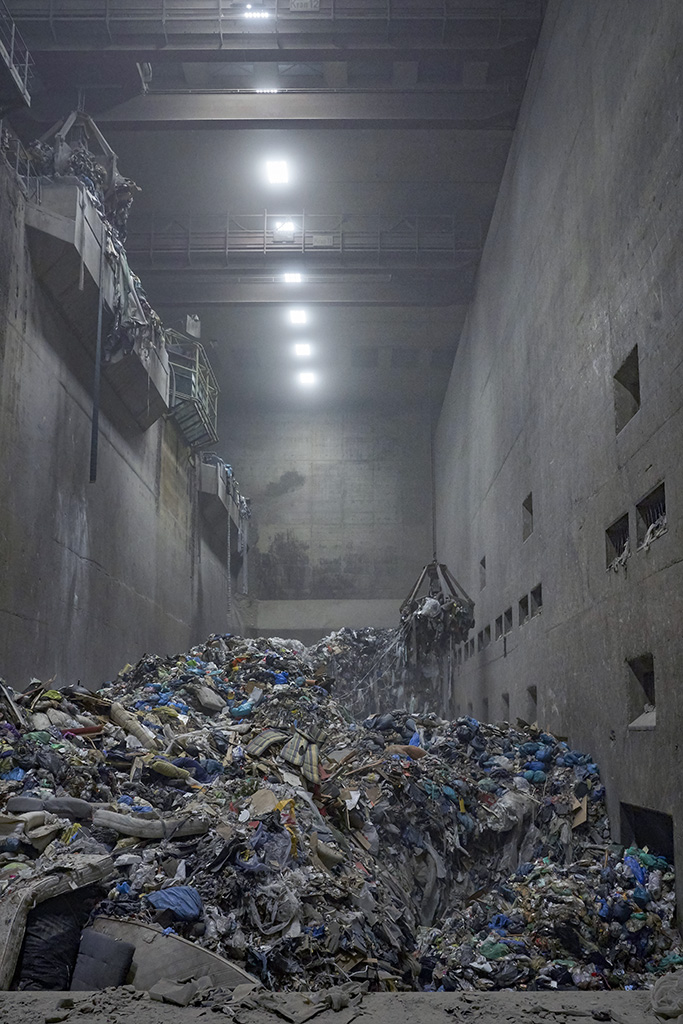
Inside the waste bunkers of the heat and power station Nord of Munich, lighting by NORKA has improved visibility and working conditions.
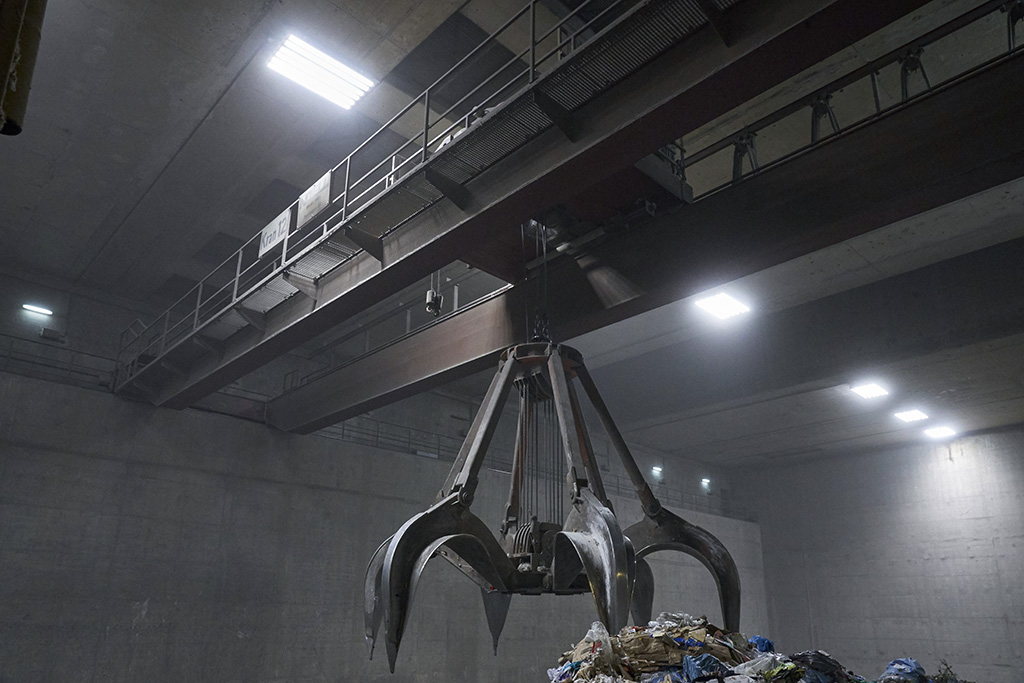
The new light quality has convinced the crane operators in particular; the luminaire's ability to be swivelled ensures an optimal distribution of light while also protecting the crane operators from glare.
To replace the outdated lighting with 1000 W discharge lamps, NORKA supplied powerful LED luminaires – ERFURT LED HIGH OUTPUT m1500 – combined in the factory to form six-lamp fittings as a project-specific solution. A total of 12 of these luminaires in the bunker of block 3 and 13 in the bunker of block 1 easily fulfilled the luminous flux requirements while offering good colour rendering at Ra>80 and a colour temperature of 4,000 Kelvin. The luminaires convinced the experts such as Gerd Manthei and his crane operators with their lighting quality during a demonstration, but also with their advantageous design: “First of all, the individual luminaires can be swivelled,” explains Manthei: “This means that we can protect the crane operators from glare and distribute the light optimally across the plane.”
Another plus point from his perspective: “The luminaire housings have virtually no horizontal surfaces where dirt could accumulate.” This is important because cleaning during operation means additional work would be required. It goes without saying that as a leading specialist for lighting solutions in harsh environments, NORKA’s new luminaires with IP65 protection rating are dustproof and waterproof and can easily withstand the varying seasonal temperatures between zero and 30 degrees Celsius in the waste bunkers.
LED technology for huge energy savings
The upgrading of the lighting in the bunkers has reduced the connected load by almost half from the previous 26.8 kW. Since the lighting is in operation around the clock, the energy savings add up; Manthei has a helpful comparison at the ready: “This means an annual reduced consumption of 57 MW/h for block 1 alone – quite a lot compared to the 2–3 MW/h consumed by a normal household in a year.” As electrical professionals, Manthei and his team carried out the installation themselves during breaks in operation, using the crane bridges as working platforms. While the luminaires in block 1 could be mounted directly on the concrete ceiling, the suspended ceiling in block 3 required an additional support structure for the luminaires, which was provided on site.
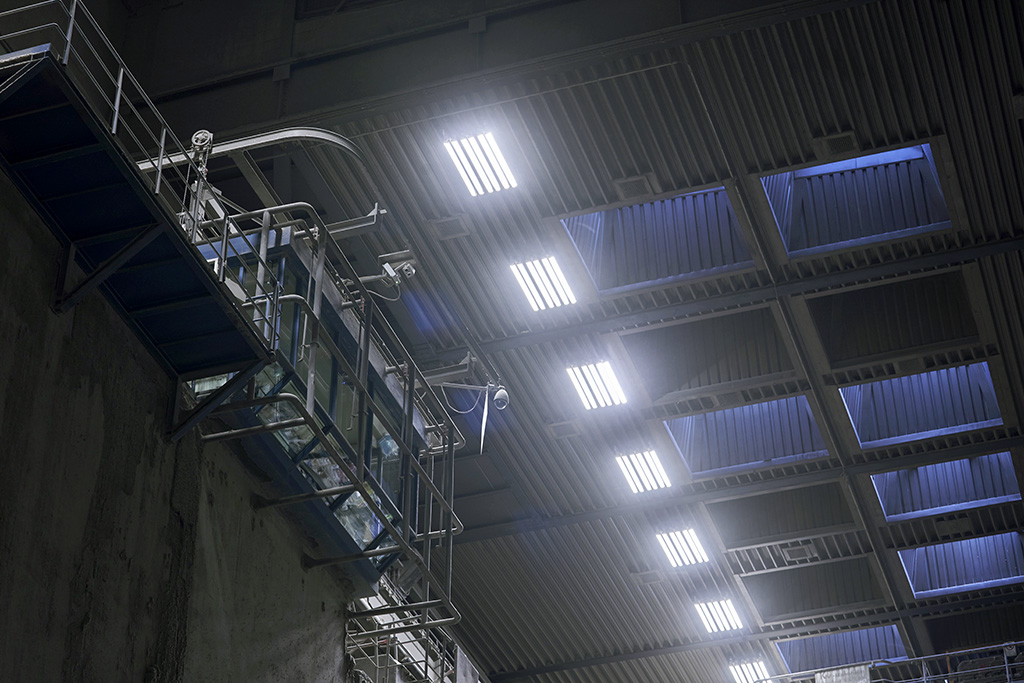
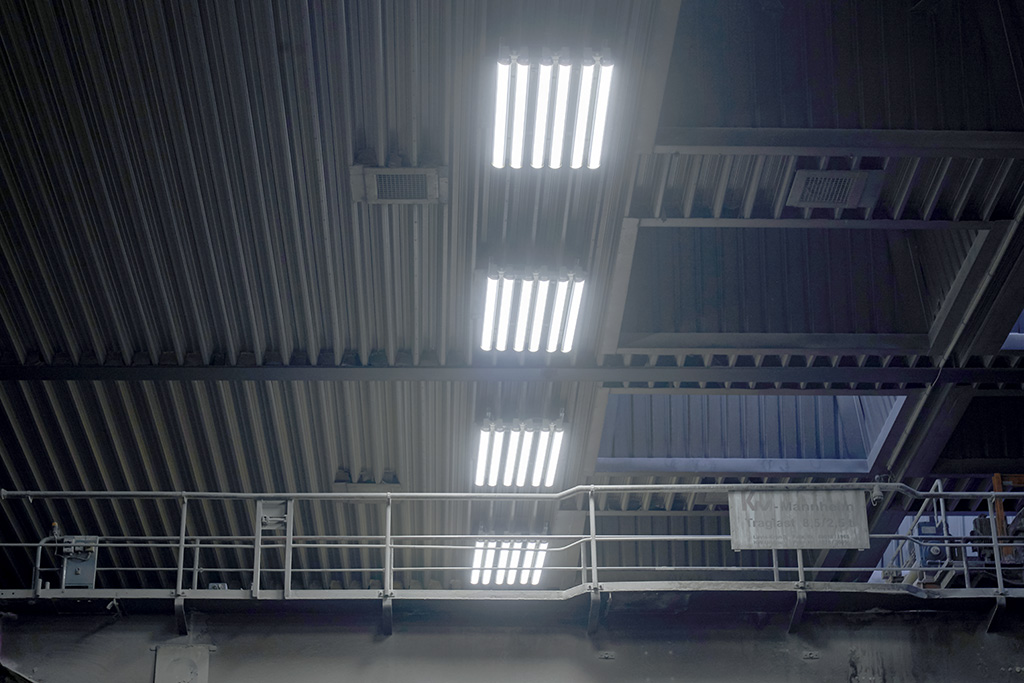
Luminaires arranged in six lamp fittings of type ERFURT LED HIGH OUTPUT m1500 fulfill luminous flux requirements easily, at the same time contributing to huge energy savings.
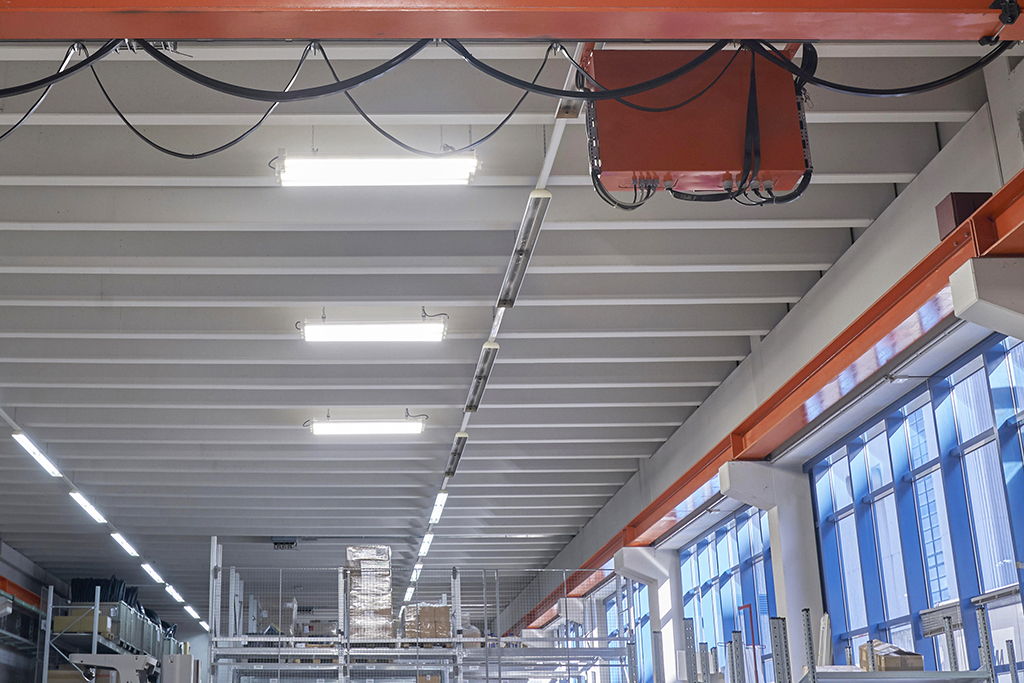
Four-lamp ERFURT LED luminaires provide excellent lightnig conditions in the main storage area.
In operation, the new system has not only proved to be efficient and reliable. The smooth switching behaviour of the LED luminaires has also improved safety compared to the old lighting: switching operations in the power station occasionally make the voltage drop for seconds at a time, causing the discharge lamps to go out and requiring several minutes of cooling time before a restart is possible. Interruptions of this kind, which have to be bridged by emergency lighting, are now a thing of the past – at the same time, the technicians have optimal visibility during repair and maintenance work in the bunker or when using a crane. Given these multiple advantages, Manthei also decided to use NORKA products in other areas of the power station to replace conventional old luminaires: this includes in the main storage area with goods acceptance and quality control, where four-lamp ERFURT LED luminaires now provide excellent lighting conditions.
Used products
Photos: NORKA/Günther Fotodesign
Used products
Do you agree to the use of Matomo?