
NORKA LED Luminaire – High-Pressure Test at DLR Göttingen
SPANDAU LED tested in high-pressure wind tunnel – safe, efficient, durable
Luminaire manufacturer NORKA has been specialised in providing good light even under extreme ambient conditions for 75 years. The products sometimes have to pass tough tests to prove themselves for use – in line with the motto “Safety first.” For use in railway tunnels, for example, the SPANDAU LED luminaire was subjected to a dynamic pressure test in the Göttingen high-pressure wind tunnel.
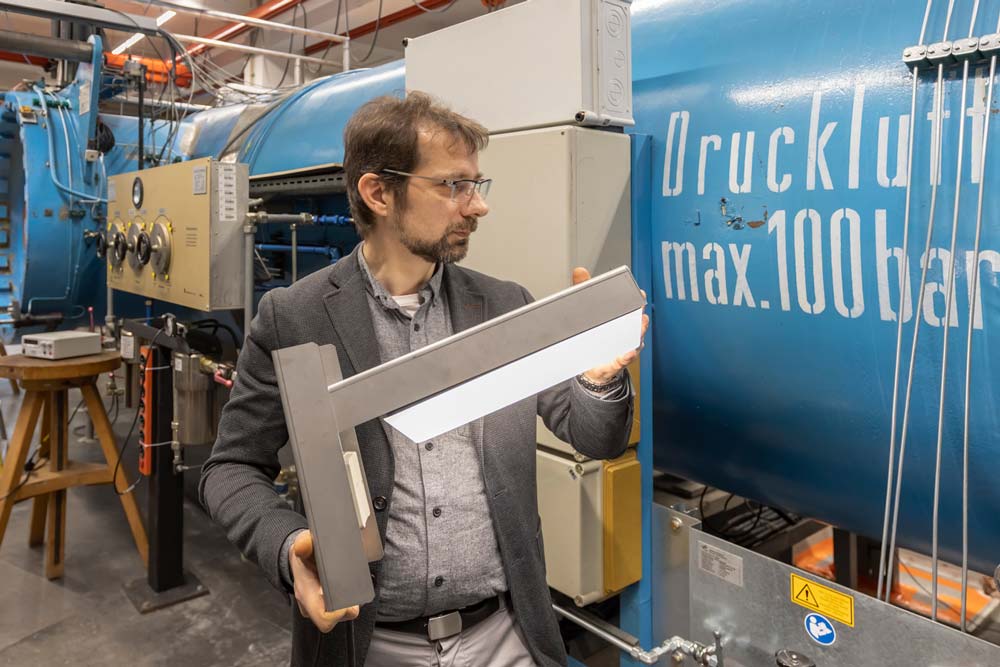
SPANDAU LED was developed by NORKA specifically for lighting tunnels, corridors and underpasses.
Anusch von Rudkowski, laboratory manager at NORKA, checks the test rig with the mounted luminaire one last time, and then the centimetre-thick steel lid of the pressure lock closes. The noise level in the Göttingen laboratory of the German Aerospace Centre (DLR) rises as a 470 kW electric motor begins to accelerate the air in the high-pressure wind tunnel. The suspense rises, as well: Von Rudkowski observes the measured values on the screen while an employee of the Institute for Aeroelasticity keeps ramping up the system. The target: a compressive strength of 5790 Pa – which corresponds to the dynamic pressure at 350 km/h wind speed. The value is reached, the luminaire stands firm. And so: even more pressure! The test is not aborted until at 6970 Pa is reached, which is significantly more than required for tunnel use. “We were firmly convinced that the SPANDAU LED would pass the test,” von Rudkowski says afterwards – but he does seem a little relieved.
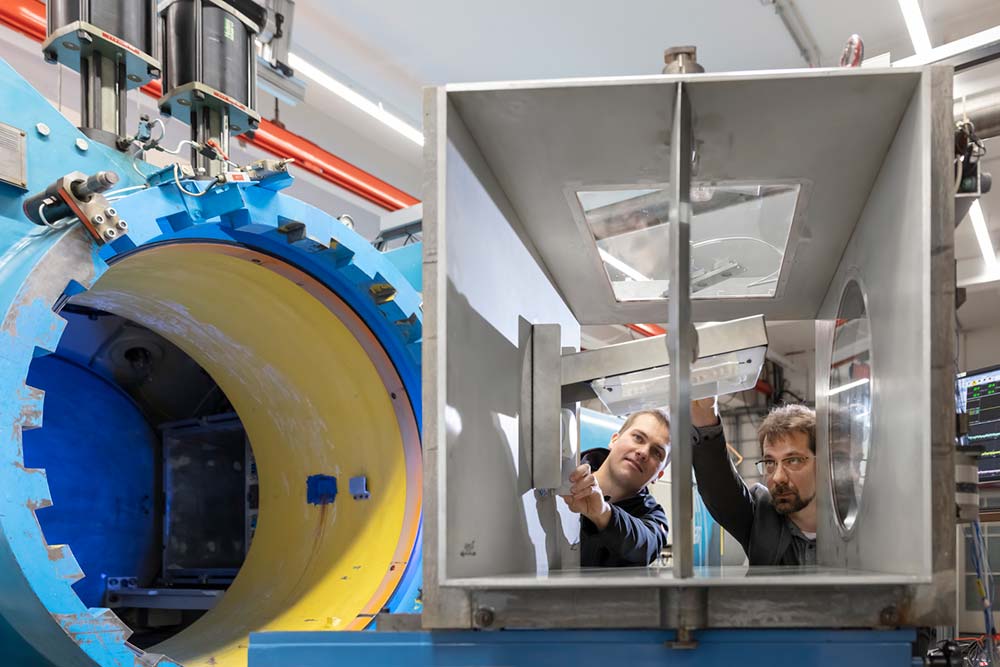
The NORKA SPANDAU LED luminaire was subjected to a dynamic pressure test in the high-pressure wind tunnel at the German Aerospace Centre (DLR) in Göttingen.
Stable even in hurricane force winds
With the dynamic pressure test in the wind tunnel by means of which the luminaire proves itself for safe use in high-speed tunnels, the point is obvious: High-speed trains generate enormous pressure waves in the tunnel air, and any lighting must be able to withstand these loads constantly. The interesting thing about the test is the details of how it is performed: The Göttingen high-pressure wind tunnel takes advantage of the fact that the same physical effects are achieved under increased pressure as would occur at a higher speed, therefore allowing high wind speeds to be simulated - for example, the 350 km/h required in the test through the combination of 15 bar of pressure and 28 m/s of speed. At maximum power, the facility at the Institute for Aeroelasticity can generate 100 bar of pressure and 35 m/s of speed: “The result is a testing facility that is unique worldwide for the investigation of aerodynamic and aeroelastic phenomena,” explains DLR Team Leader Dr. Marc Braune, not without pride. When measuring the luminaire, the engineers used 14 acceleration sensors to determine how much the housing and the fixture were loaded and vibrated.
Light – tailor-made for railway facilities
NORKA has developed the SPANDAU LED luminaire especially for the lighting of tunnels, corridors or underpasses. Its extremely wide beam “Batwing” light distribution allows a generous luminaire spacing of up to 17 metres, reducing the number of light points, as well as the investment, operating and maintenance costs. A stainless steel wall bracket, polymer housing and polycarbonate luminaire make the luminaire extremely resistant – which was impressively emphasized by the pressure test. As a supplier of lighting in track-side areas, Norka must fundamentally fulfil strict regulations. In addition to the specifications and rules of DIN EN 60598 and DIN EN 12464, these regulations include further company-specific electrical and lighting guidelines, as well as planning specifications for the safety of employees and customers.
To mention just one example of how NORKA luminaires for the railway sector differ from standard products: They are equipped with SELV (Safety Extra Low Voltage) driver and LED modules; i.e., galvanic isolation from the supply mains is provided from the secondary side onwards. The supply voltage of the LED modules is limited to non-hazardous values, which makes maintenance work easier and safer. As a former sales manager, Florian Schönfeld, Managing Director at NORKA, is very familiar with railway requirements: “Our luminaires are already robust by design,” says Schönfeld and adds: “But only our flexibility and customer focus have allowed us to work successfully with transport companies all over Europe for many years.”

Interested or further questions?
Find your contact person:
Photos: NORKA/Frieder Blickle
Do you agree to the use of Matomo?