
ENERGY-EFFICIENT LED LIGHTING FOR KARLSRUHE TRAM
Innovative LED luminaires for safe, efficient and comfortable lighting of the Karlsruhe tram system
Energy-efficient LED lights provide bright and sustainable illumination for Karlsruhe’s subway stations. The city in Baden is considered a pioneer in public transport: its light rail lines have been successfully extended into the surrounding regions without requiring transfers. Due to increasing demand, the inner-city routes soon reached their capacity limits. Since the end of 2021, trains have been running underground through the city center.
For the new stations, Karlsruhe relies on the robust and durable LED lights from NORKA. They not only offer excellent light quality and a pleasant atmosphere but also save energy thanks to cutting-edge technology – an important contribution to sustainable public transport. With these energy-efficient LED lights, passengers benefit from safe, well-lit stations while the city and operators reduce costs and conserve resources. NORKA supports cities and transport authorities in implementing efficient LED lighting solutions for light rail and subway stations – for greater comfort, safety, and sustainability in public transport.
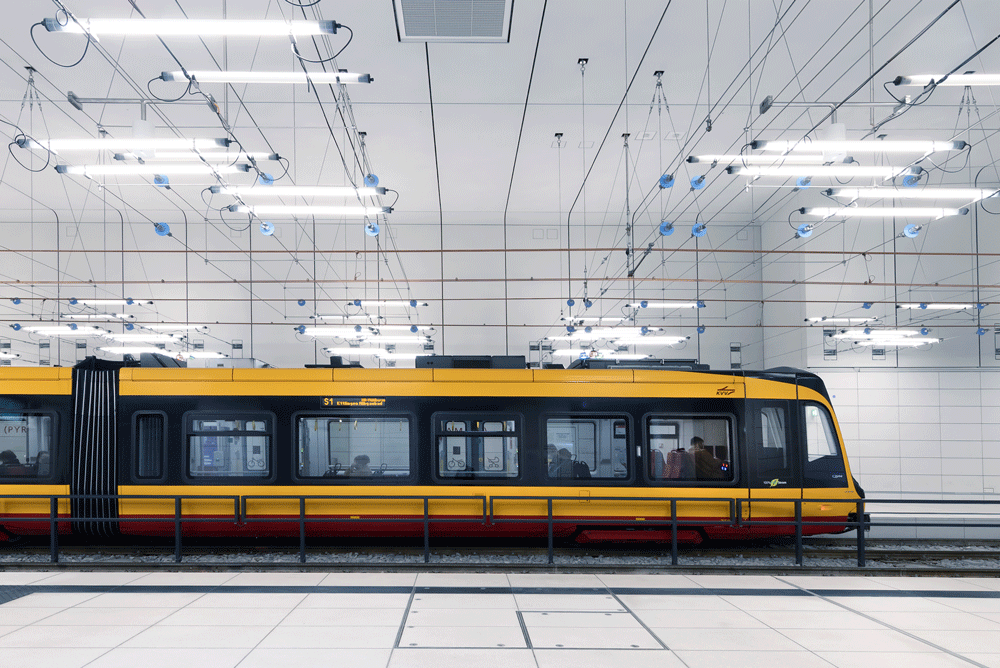
NORKA luminaires provide convenient, pleasant lighting throughout the stations.
It was a long time coming, but relocating Karlsruhe’s central light rail line underground while it was still in operation was a major feat; after all, the construction site ran right through the heart of the city and its vibrant urban community. In 2002, the citizens of Karlsruhe held a local referendum, voting in favour of running the light rail underground in the Kaiserstraße area. After around twelve years of construction, the busy shopping street has now become a true pedestrian zone. Along the 3.4-kilometre stretch there are now seven underground stations, planned by Munich architects Allman Sattler Wappner and illuminated by the Ingo Maurer office. The firms took part in the 2004 competition together to design the stations and came out as the winners.
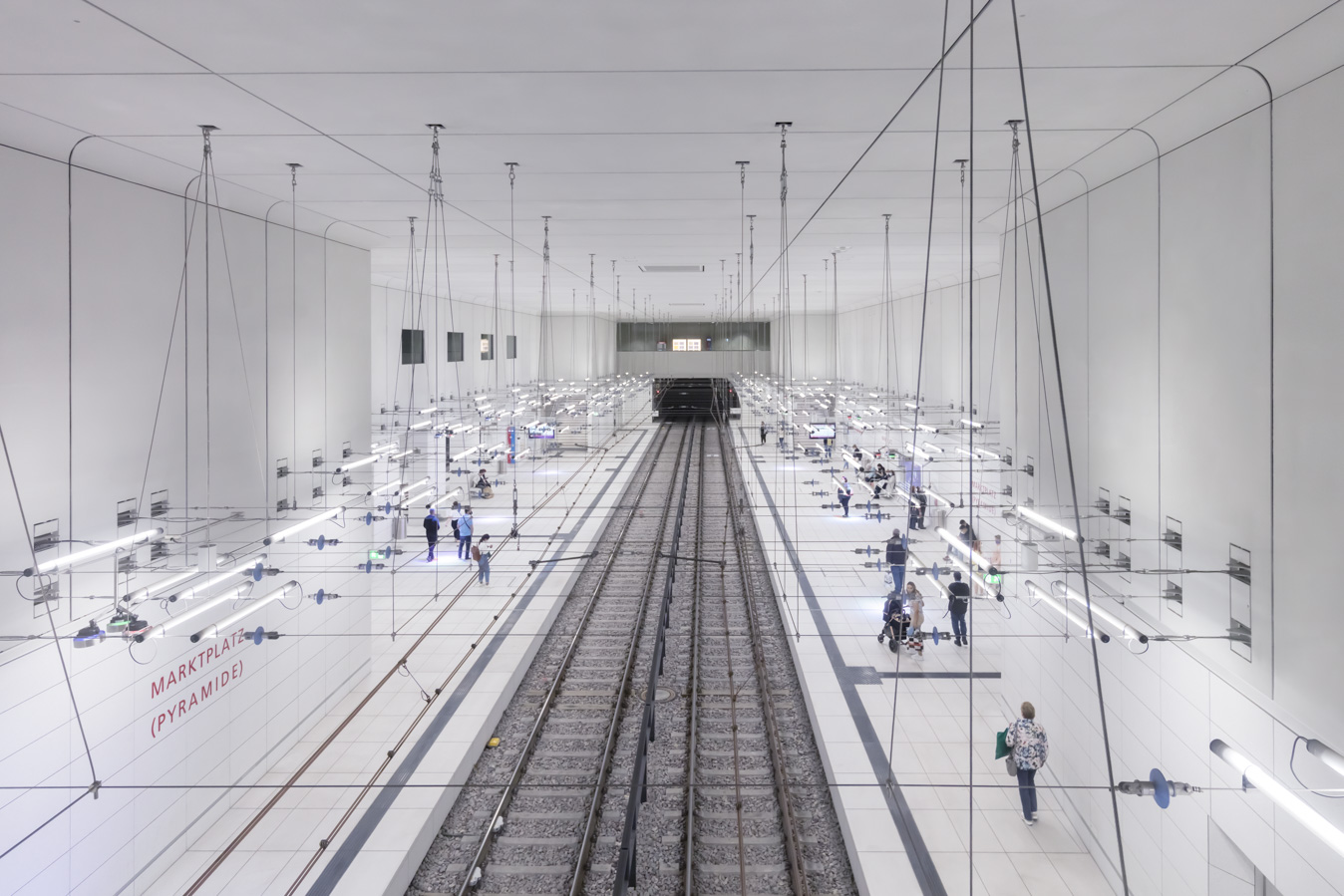
Although the seven stations are geometrically very different from one another reflecting the city’s structure, they follow one basic idea in terms of design: namely, a minimalist, serene look, a bright atmosphere, differentiated surfaces and homogeneous light.
Although the seven stations are geometrically very different from one another reflecting the city’s structure, they follow one basic idea in terms of design: namely, a minimalist, serene look, a bright atmosphere, differentiated surfaces and homogeneous light. This in turn was created by Ingo Maurer – and by NORKA luminaires. The Hamburg company provided technical ZUG LED serial luminaires, which were used by the light designers in a completely new way to their usual one. “Technical” doesn’t necessarily mean that design is compromised – rather, it actually provides for greater scope. When it comes to more creative thinking that is. Which is precisely what Sebastian Utermöhlen – manager for major projects at Ingo Maurer – and his team did in the most impressive fashion.
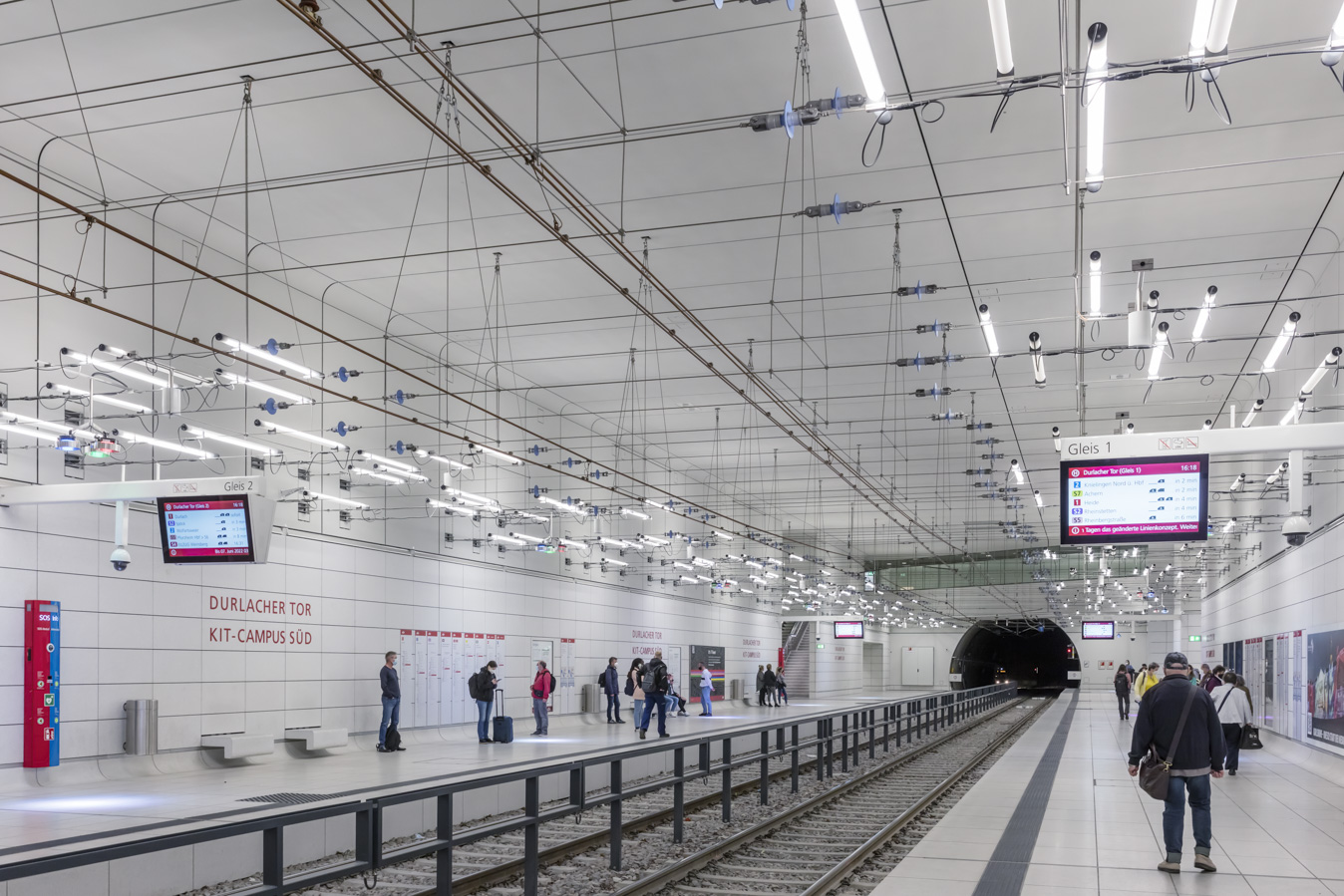
NORKA provided technical ZUG LED serial luminaires, which were used by the light designers in a completely new way to their usual one. “Technical” doesn’t necessarily mean that design is compromised – rather, it actually provides for greater scope.
A symphonic luminaire arrangement
The lighting concept for the platform level refers to the overhead line, the element that is present in all stations but is actually below the perception threshold. In fact, the lighting designers have added a second, even a third, layer of overhead line through the stations – at right angles to the direction of the track, consisting of steel cables, clamps, tensioned wires and insulators. This “rope web”, as Utermöhlen calls the intricate, overlapping construct, ultimately serves to support the tubular luminaires. At first glance, they seem to merely rest on two pairs of ropes each, as if they were floating in the airy volumes of space. However, they are of course securely fixed – this having been tested in suspension tests on a 1:1 model. In the process, the lighting designers also determined the placement of each individual tubular luminaire, as well as the exact shape of outgoing cable loops. Or, to use Maurer’s poetic language, the luminaires were arranged symphonically.
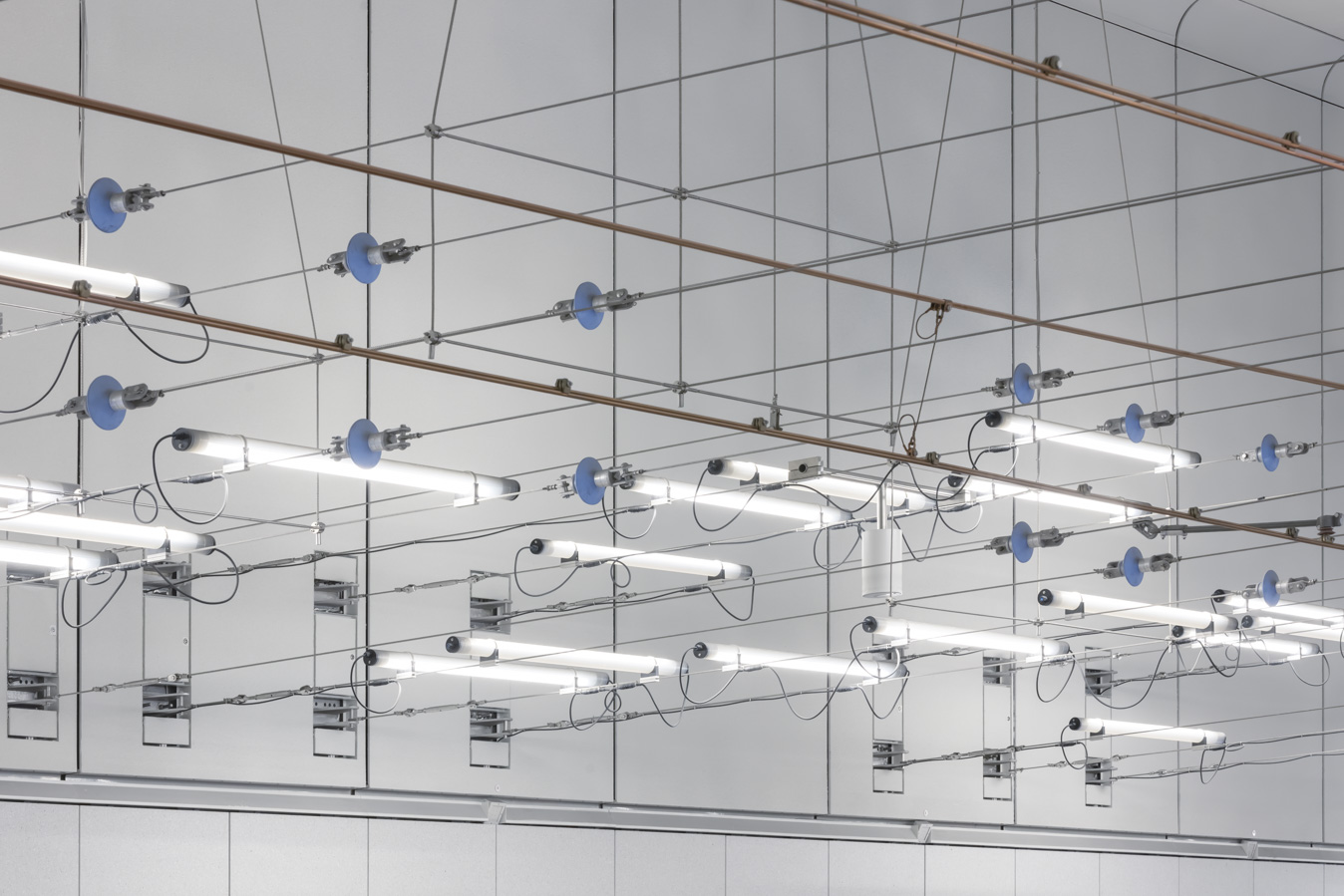
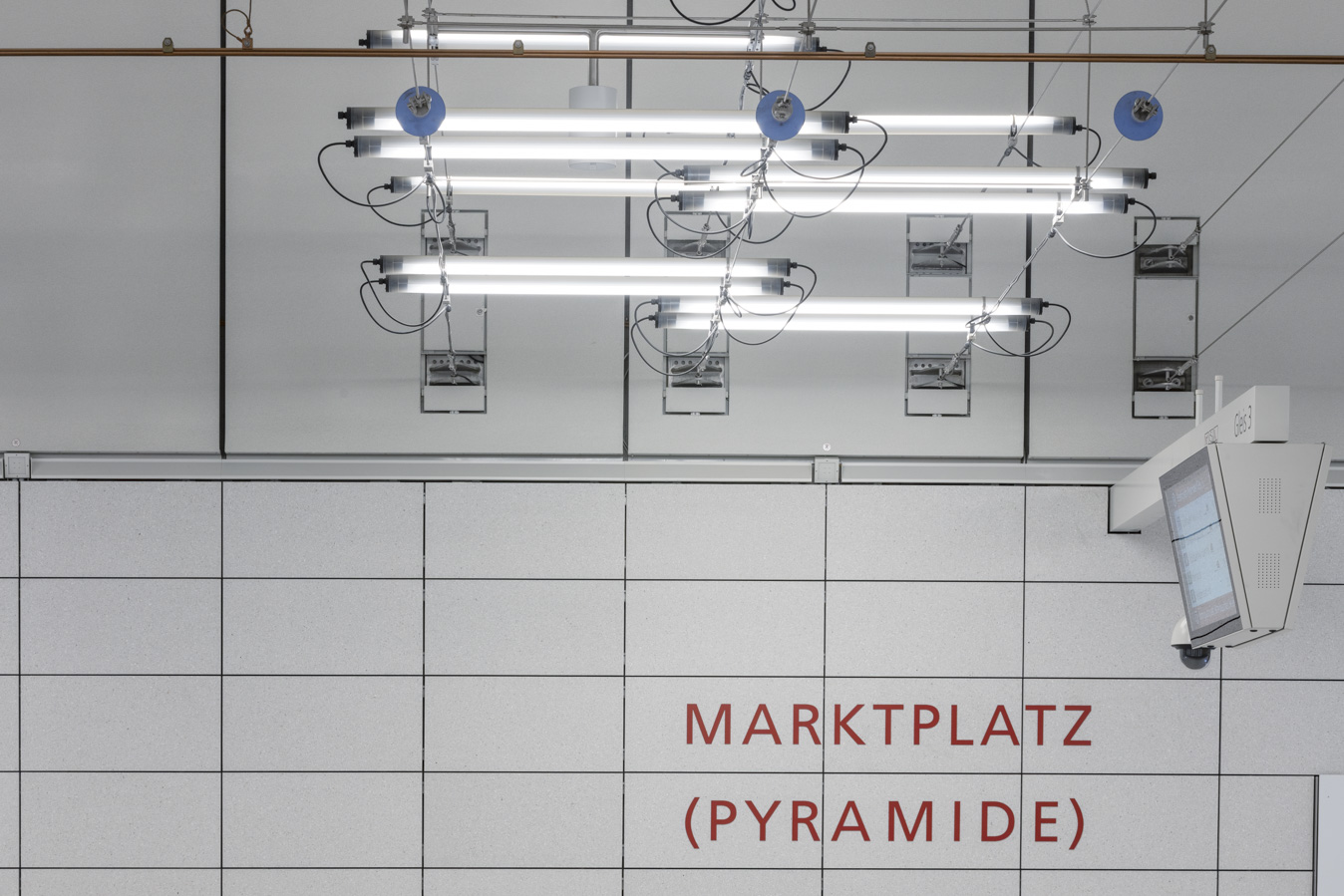
Despite this seemingly random, irregular design, it achieves the required homogeneous illumination of the light-coloured platform halls.
Positioning of the ZUG LED tubular luminaires is not bound by a fixed pattern; some appear to float more closely together, others more loosely apart, overlapping vertically as they are arranged on two levels. Despite this seemingly random, irregular design, it achieves the required homogeneous illumination of the light-coloured platform halls. Two thirds of the tubular luminaires emit their light primarily downwards, one third upwards towards the ceiling.
The rope principle is reminiscent of the early, playful rope luminaires of the low-voltage halogen era, which Ingo Maurer played a key role in shaping. In this case, however, there is an additional, quite practical aspect: the flexible adaptation to the different heights and layouts of the individual stations. The steel cables can be very easily adapted to the respective spatial conditions without forsaking the design concept.
Incidentally, Utermöhlen and his colleagues drafted the 2004 design with an open mind to technology. At the time, LED technology was a relatively new concept, which meant that sufficient scope was needed to be able to adapt the design to the lighting technology. In the end, however, the question of which lamp to use proved irrelevant, LEDs not being the current state of the art. Consequently, a total of 1984 ZUG LED tubular luminaires were installed in the seven stations, producing glare-free light with 4000 K and 4270 lm. The luminaires are almost 150 centimetres long, designed for tough environments and practically maintenance-free. What’s more, they’re extremely robust. The cylindrical luminaire body is made of impact-strengthened PMMA; the luminaire is resistant to oil and alkaline solutions, has an age-resistant sealing system and can even be cleaned with a high-pressure cleaner in the IP69K protection class version. And thanks to its streamlined design, the ZUG LED fits perfectly into this challenging setting.
Used Products
Photos: NORKA/Frieder Blickle
Do you agree to the use of Matomo?